Visit us
Inca pottery interpretation centre
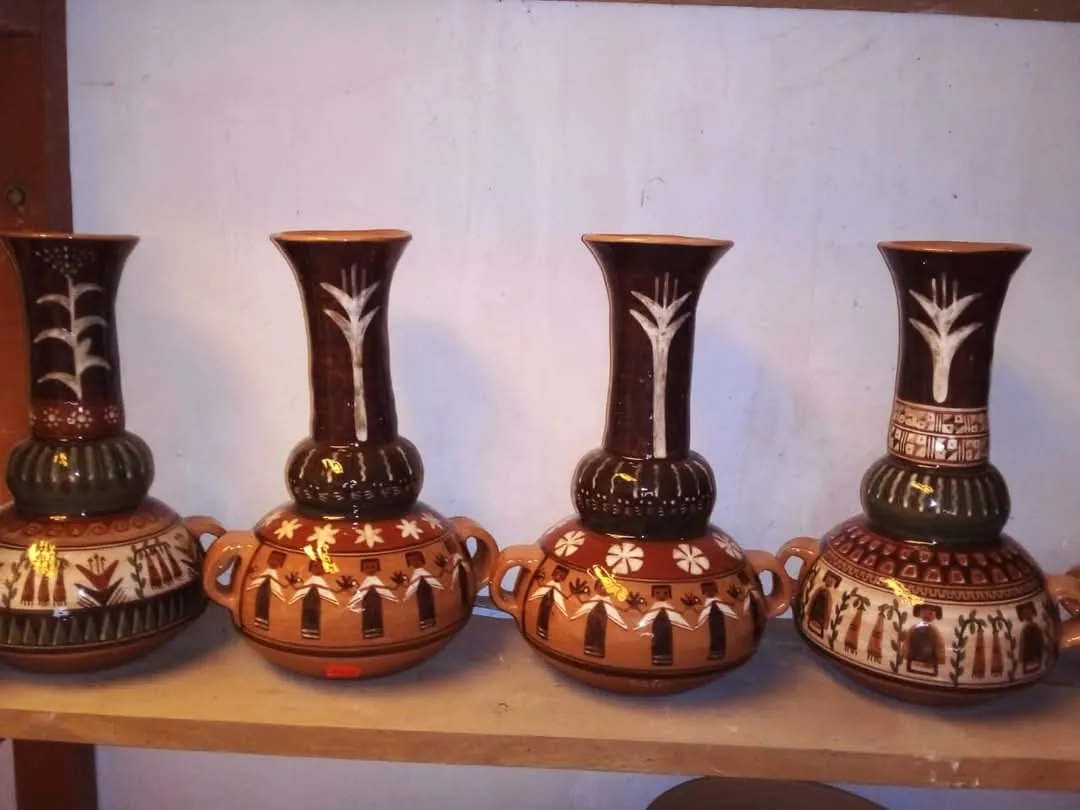
At the Sañu workshop in Raqchi we show how pottery was made, and is still made, in the area: the materials, tools and techniques that date from before the Incas. You can make a piece, decorate it with natural pigments and get to know Raqchi.
- Capacity10 people per day
- Opening hoursArrange on WhatsApp
- Bookings929 437 218
Timeline
Pottery in Raqchi
Around 1000 BC
Early Horizon
The Raqchi site museum holds fragments from this period, with incisions and a paste similar to Marcavalle pottery from Cusco. They were fired in open bonfires or open kilns, at low temperatures.
Regional states
Pukara and Wari
Influences arrive from the high plateau and from the Wari culture. A bottle with red slip and a face in high relief was found in Raqchi, and the site museum keeps polychrome Wari pieces.
Late Intermediate
The Canchis
A local culture in the Vilcanota valley: vessels with incisions on the neck, plates and cups with slips, and a serpent drawn in black.
Inca
The Temple of Wiracocha
The Inca Wiracocha has a great temple built in Cacha, today Raqchi, according to Inca Garcilaso de la Vega. Cusco pottery is made with repeated shapes and designs, such as the aríbalo and the kero.
Today
Cultural Heritage of the Nation
Raqchi's potter families still make pottery with the same techniques. In 2018 Peru's Ministry of Culture declared this knowledge Cultural Heritage of the Nation.
Based on the studies of Irvin Ferrandiz and Bill Sillar on Raqchi and the Royal Commentaries of Inca Garcilaso de la Vega, gathered in the newsletter "Cerámica ancestral de Raqchi".
Tools
The potter's tools
They are the same as, or very close to, the tools Inca potters used. Their names are in Quechua.
- Taqllina
- Sandstone with one flat side. It flattens the clay to start any vessel.
- Muyu
- A simple turning base that holds the piece while it is built.
- Lapiqara
- A piece of damp leather to finish the rims.
- Llauchina
- A deep dish of water for shaping and keeping the lapiqara damp.
- Rump'u chawina
- A round stone that evens out the inside of the base.
- P'alta chawina
- A long flat pumice stone that shapes the round inside and smooths it.
- K'isuna
- A metal blade about 15 cm long that evens out the clay rings.
- Chucuna
- An awl that removes air bubbles.
- Lluncuna
- A smooth stone to polish the outer surface.
Shapes
Shapes of Inca pottery
Classification by archaeologist Luis A. Pardo (1939). Some are still made at the workshop.
P'uyñu (aríbalo)
The most representative piece: ceremonial and for daily use, brightly colored.
See in the shop →Q'ero (kero)
A drinking cup.
See in the shop →Manka
A round or cylindrical pot, flat-based or with three legs.
Aisana
A small jug to carry around, similar to a cup.
Ccocha
A cup.
Urpu
The largest piece, globular in shape.
Firing
Two kilns
Open kiln or dung bed
A ring of volcanic stones (khankarumi) with layers of wood and dung. The pieces are stacked up to a metre high, covered with straw and fired for 4 to 6 hours. Cooling takes all night.
Adobe kiln
The one most Raqchi potters use today, probably introduced in colonial times. It burns local shrubs such as roq'e, and firing takes 4 to 8 hours.
Source: newsletter "Cerámica ancestral de Raqchi", by Máximo Amaru Mamani and Sayda Choque Chuquihuanca.